Introduction
Welcome to Undercurrents, our deep dives that explore a trend that we feel has the potential to drastically disrupt or change the way thousands of coworking businesses run or grow.
Hector Kolonas, co-founder at Syncaroo, is your host for this edition.
In this edition, we’re gonna dig into The New Revenue Stack and how, after around 20 years of coworking, we’re starting to see some major shifts in what we offer, how we monetize, how we provide hospitality, but also how we create more profitable and more sustainable businesses.
We’re gonna dig into expert led insights, what’s worked, what hasn’t worked, what operators would recommend, what they would recommend avoiding, and all of this stuff that happens in the messy middle of trying to build great, sustainable community driven coworking businesses.
Foreword
Undercurrents are produced and distributed online, in PDF, audio and, video, so that their content is as accessible to as many coworking leaders as possible around the world. For free.
To do so, each Undercurrent edition is underwritten or sponsored by one partner.
This edition is brought to you by Syncaroo.
At Syncaroo, we’ve seen time and again that unblocking a flex space’s best people not only boosts their job satisfaction and efficiency but also increases the firm’s profitability.
Much of our work involves helping workspace operators shift from an outdated people-smushed-together-with-technology approach to what we call an Operating Stack, in which technology is orchestrated around the day-to-day workflows that enable your people to do their best work.
We’re constantly inspired by the improvements, pivots, optimizations, and entirely new flex space products that teams on the ground can develop and introduce when they’re unburdened and unblocked from error-prone, repetitive, often onscreen, busy work.
To follow up on our last Undercurrents edition, which we sponsored on Fractional Offices, we wanted to dig deeper into some of the new revenue sources that have worked, and those that haven’t, from leaders across a broad spectrum of coworking spaces.
We hope that you enjoy this edition and that it inspires your next big moves.
Hector Kolonas
Co-founder at Syncaroo
Meet your experts.
In each edition of Undercurrents, we don’t just tell you what we’re seeing in the news, behind the scenes, and between the lines.
We also bring in experts from across the coworking world to share what they’re seeing, what they’re doing, the challenges they’re facing, and how it’s affecting coworking businesses.
This edition is no different.
Here are some experts who volunteered their time, insights, and honesty about AI agents for coworking spaces.
Note: Quotes in the written formats may have been edited for brevity and clarity, but they maintain the same content and context as the audio and video versions.

Some fundamentals.
Before we dive into the insights we gathered from these teams, I want to start with three fundamental observations we’ve seen throughout 2025.
There are one or two monumental shifts in what we offer, but also what companies and individuals are now expecting from physical spaces, be it for work, for production, for creativity, for rest, for gathering, and how that impacts our businesses and the products that we can put together.
Another paradigm shift is that many operators are realizing that not all revenue sources are created equal when it comes to blended overheads, tricky margins, and human capital. All of these coming together allow operators to determine which products to double down on, which to pull back, and where sustainability lies between creating the best, approachable, and accessible products and just chasing the bottom line.
Now, the last point I want to note is the fact that everyone we spoke to, not only in these interview sets, but throughout the year at conferences, in the newsletter, and in our other conversations.
The same trends and shifts are being seen and felt across every type of coworking business, from indie operators to three-location operators and multinational operators, and across almost every region.
There are nuances around the types of spaces and customers driving the tremendous growth we’re seeing in India, as well as landlord-driven approaches in the rest of APAC. And also the more measured, strategic growth we’re now seeing across US markets.
With those three, let’s dive into what is actually happening and changing in the revenue stack of coworking businesses.
Current Revenue Stacks
Before we dive into emerging changes, we should first examine what the average revenue stack looks like in 2025.
Our experts each shared the rough percentage breakdown of their revenue across traditional “memberships” (hot desks, flex desks, coworking, etc), “on-demand products” (meeting rooms, event spaces, day offices, and passes), “offices“, and “other“.
Other includes some really creative things that they’re gonna share with us in this edition.
Averaging their numbers, we arrive at a rough average stack that looks like this:
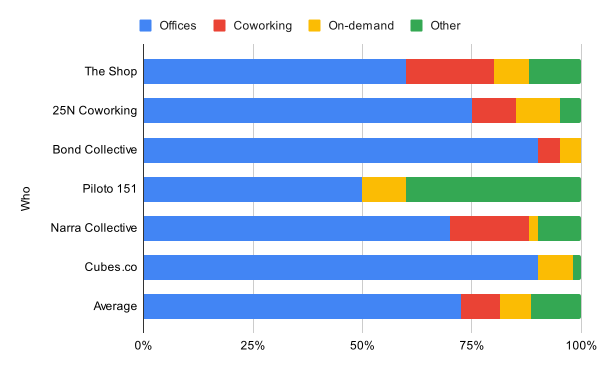
Private offices still account for around 72.5% of revenue across the six entities. What’s interesting, though, is what the remaining 27.5% indicates about the rev stack.
While 8.8% of total revenue is attributed to traditional coworking membership products, on-demand products now account for 7.2%.
We’re seeing on-demand and traditional balancing out, with both coming toward the 8% level.
The Other 11.5%, though, that’s coming from offerings that are new, experimental, or not traditionally bundled into the coworking value proposition.
What is being offered?
So what exactly are operators putting together that’s different or non-traditional?
Let’s start there…
We have been playing around more with just, like, monetizing hospitality.
We have a robust food and beverage offering, so when people make on-demand bookings, we charge an administrative fee to ensure they receive the best local bagels for breakfast and all their coffee needs.
Beyond that, we’re working to implement a more robust concierge program, for example, before Valentine’s Day, facilitating pre-orders of floral bouquets for our members. Just helping take items off their list, with a small fee to reflect the work involved, while also supporting a local florist.
Many options have nothing to do with how much space each member occupies, but can generate additional revenue.
And I continue to be surprised by what we can bring in and what people will pay for.

We do quite a bit. Our package revenue is significant.
We offer meeting room packages; we don’t include any monthly hours unless they need a larger group or space, and that’s part of the deal we work out with them.
We do mail, of course, we’ll do scanning and forwarding, and any virtual memberships.
We’ll host community events, and that’s a separate membership as well. We do concierge and catering services. That’s an add-on for meeting rooms and event services.
We provide installation and service, enabling us to develop custom IT packages aligned with members’ compliance requirements. We offer a range of printing packages.
We have a design firm under our umbrella, it’s called Workplace Studio. As a result, we can also provide tenant improvement and design services for users.
We offer different storage options, including lockers and custom storage, depending on their needs. We work closely with our landlord and developer to ensure we can offer that wherever possible.

One of the things that we do a lot of, which has been increasing significantly is productions.
Movie shoots or TV shows will come in, rent space for a week or sometimes a couple of months, and use the offices as writing rooms.
We have a strong community of production crews and scouts who value our locations because they work well for the writing rooms, and sometimes they also use them for actual shoots.
We do a lot of rentals, at least five to six per month. And what’s great about it is that the scouts who come in don’t have much back-and-forth. They already have a budget for the location set. They’ll say, “Hey, I need a writing room. I need it for four weeks. This is what I need. It has to have this many desks, this many chairs, or no desks in chairs ’cause we’re using it as a fitting room and this is what we’re willing to pay.”
And it’s usually at pretty competitive rates. It’s a significant ancillary income stream for us because we can offer them vacant offices. Especially if it’s for a week or two and in the middle of the month, it’s typically not an office we’re going to rent mid-month.
We’re focusing on rolling this out across all locations, as we’re seeing a significant increase in demand for production suites.

At the shop, we prioritize easy and repeatable processes. We carefully consider how our operations fit into daily activities to enhance our income goals. Let’s take a brief look at the origins of our shop in Salt Lake City.
Salt Lake City is known for its soda culture, particularly “dirty soda” with popular brands like Thirst and Swig. When we developed The Shop, we aimed to replicate our New Orleans beverage program but faced a legal barrier: we couldn’t offer beer on tap.
To enhance the beverage experience, we installed a soda fountain, which proved to be a successful addition. This was built into our budget as we understand that a great beverage can make a difference in someone’s day.
Recognizing this, we started selling unlimited beverage passes for conference room guests at $10 per person. With a glass of soda costing just 8 cents and coffee options never exceeding a dollar, it’s a fantastic deal compared to other retail prices.
This add-on has become popular, generating significant revenue from conference bookings for groups of 8 to 20. Additionally, we offer preset breakfast, lunch, and dinner menus, each with a 15% administrative fee. This straightforward approach allows us to increase our revenue by over $1,000 per month through these appealing offers.
The virtual mailbox offering has performed very well since we launched it in June. The challenge has been getting that CMRA approval.
But in the current landscape, since we support business owners and new founders, having mailing services and business addresses is very important to them.
We see this as a revenue driver: they start as a virtual mailbox client and then transition to working within our space.

There are many add-ons for virtual offices and memberships in general, and we love that type of revenue.
It’s what I call good revenue. Anything scalable beyond your square footage is a great revenue stream.
One of the things that you can see clearly when you structure your virtual offices correctly, and for scale, is that you do have quite a bit of revenue coming in from add-ons, and then of course quite a bit of revenue coming in from postal mail management.
Those two revenue buckets are not created equal; they differ.
But a well-structured virtual office offering will have add-ons and the types of add-ons that I love, right, additional entities. It’s the most important and overlooked add-on for virtual office memberships, and for other memberships as well.
This is where you might have a ton of serial entrepreneurs in your spaces, and you’re not capitalizing on it.
We have members who have registered with 40 different companies, potentially under different partnerships, projects, and other arrangements. And guess what? Each of those corporations needs a business address, and they will start receiving postal mail.
So the key for that add-on is that you don’t want to charge the exact amount you charge for your traditional virtual office. Because that’s not sustainable, and it won’t get that person to then use your services for the 39 other companies that they have.
You want to make sure it’s discounted. Quite heavily. For our additional entities, we charge $35 (vs. approximately $ 80 for a virtual office plan).
That’s how we now have clients with 40 different memberships with us, and it’s a great add-on; I can’t speak more highly of it.

We have creativecubes.co and corporate cubes.
Corporate cubes were formerly Workspace 365 Victoria. We acquired them just a little over 12 months ago. It blows my mind how much that business does in virtuals.
Combined, it’s equal to one of our centers. So, five of their virtual business centers equate to one of our smaller centers in total monthly revenue.

Beyond our office and desk offerings, our event space business is performing very well.
We found at the outset that demand for event space is very high, whether for private events or for practitioners looking to host workshops or yoga sessions, networking, and everything in between.
We began developing a membership model for event organizers to make it more accessible to these groups and organizations.
From our end, it also stabilizes our revenue and makes it more predictable.
We are a very diverse group here at Piloto 151.
What that means is that yes, we do a lot more than just coworking.
It’s not necessarily under the same umbrella, but it does happen and becomes part of the value add for our members.
Examples include soft-landing services in Puerto Rico, including incorporation.
And that’s great for us because, since we handle the incorporation, we’re also using our Piloto 151 space business address as the address for those new incorporations, which in turn means those clients will be longer-term clients.
So it’s all connected. We even help people relocate to the island.
We’re really hyper-focused right now on NLA (non-lettable area) revenue.
We already have the NLA as a cost center in our P&L.
So how can we squeeze the lemon, but not for the sake of squeezing the lemon, but add actual value to an experience and service?
So our virtual business is quite significant. Our RISE network is not massive today, but it is growing faster than any other business unit that we’ve ever had.
Our podcasting business is a cost center in terms of NLA, but it’s a revenue generator, not only for our business, but it’s actually a huge revenue generator for our ad network.
We have 15,000 members, and many companies are approaching us, asking, “How can we tap your audience with our products and services?”
We operate an extensive ad network with air servers in all our meeting rooms. A hundred plus rooms that are seeing a different audience every 30 minutes – and when the screen’s not in use for presentation, it’s running ads. We also run ads through our center.
That revenue is likely $4,000 to $5,000 per center per month.
Beyond the four walls.
Now, on the topic of increasing revenue per member. We’re seeing a big trend of operators expanding their services beyond their member base.
So, taking services to landlords, taking services to neighboring businesses, providing a service to a broader network, generally throughout the building, but also in the surrounding neighborhood.
Are you doing anything that extends the reach of your services without necessarily including selling square footage?
Yes, actively. So we’re in, we’re in discussions with a couple of our landlords.
For example, one landlord had a vacant space in the building and was looking to convert it into an amenity for tenants.
And they came to us and said, “Hey, we wanna just build this office with conference rooms, and that’s really it, we wanna offer it.”
We went back to ’em like, “Hey, well, these are the things we need to think about. This is how it gets done. You, you guys don’t want to do this. You don’t have the infrastructure for it. This is not what you do. Let us manage it for you?“
So we’re now doing that in two of our buildings. Then it went well enough in one of our buildings that we’re in discussions with one of our landlords, who also has a residential portfolio. They’re looking to do something similar, but with a coworking space within the residential building.
And they’re like, “Hey, just come manage this for us.”
Yes, we’re actually doing it right now.
It depends on the building and the type of property the landlord owns, but we do this exceptionally well for one specific property, and we’re excited to explore it further.
Right now, we are managing nearly the entire campus for them. We are handling all community events. We’re doing the meeting room spaces that they have that are included for their other tenants. So we’re managing that.
Before we came on, they were using it only once or twice a month, and we were able to activate that space for them.
We have certain landlords and development partners with gyms that could be located on a specific floor of their buildings. They have asked whether we want to manage that ourselves or bring in a third party.
Wellness spaces aren’t exactly in our wheelhouse for the gym, but we’ve considered them. Right now, we’re focusing on community spaces and local events for the whole campus.
There are community managers landlords can hire to manage the entire building and host local happy hours and similar events, but we’re already doing that. Hence, we incorporate that whole offering into what we’re already accomplishing.
We have a site in Collingwood, where in the building, as part of our membership, we have Lululemon on the floor above us. We operate on four floors at that site.
Level five is Aesop, the cosmetics brand. And then the floor above that is Swiss Vitamins or Swiss Wellness, which is also quite a significant brand.
Swiss and Aesop came to the building and actually reduced the floor area so they don’t have much customer-facing space. They actually meet all their customers on our ground floor, which has a reception area where our happiness team sits.
It has meeting rooms, a cafe, and an event space. And so, in terms of offering it to the broader neighborhood, you can download our app and book a meeting room on demand. Within the asset we operate, we enable larger organizations to reduce their floor space and actually act as the front of their customer-facing service.
So, not in as much as like Aesop has, shops and all that, but like from a corporate head office perspective. Every other day, they’re using our event space to present to people, which, historically, would’ve happened on their own floors in their own private meeting rooms, etc.
And we’re seeing a lot more of that as we expand. In Adelaide, the company that occupies the most space in our building has also reduced its NLA and is plugging into our front, so that when their guest arrives, that experience is not on their staff; it’s on us.
For other business lines, we offer on-demand access to our space for day passes and conference room use, as with all coworking spaces. You don’t have to be a member to use those services.
Now that we’ve added our event venue (featuring nearly 10,000 square feet of floor space, including breakout rooms, meeting rooms, and flexible configurations), we’ve opened the door to a different type of client we didn’t previously serve.
So we do have that revenue. We also offer brokerage services beyond our spaces and buildings, and we provide soft landing services to clients who don’t necessarily need to be members.
Inevitably, they end up becoming members, and that’s the lesson here: you want to make sure that you have the availability of these services for the general public, but that’s a shoo-in. You want to convert that into a membership because, ultimately, we all know we are in the membership business.
You want to make sure that monthly recurring revenue is as high as possible.
As a result, when you look at our revenue stack, many would be surprised to see that we derive only about 10% from these additional services and on-demand products.
That’s because our team excels at converting one-time clients who walk through the door for these products into membership clients. We do this with conference room memberships; we just launched event venue memberships, virtual offices, and our cafe memberships.
So all of this is part of the strategy here at Piloto 151.
Disappointing Revenue
Now it’s not all gravy, it’s not all gonna be bells and whistles. It’s not all gonna be up and to the right.
Sometimes we try things, and the nature of experimentation, and of trying to prove hypotheses, is that sometimes we’ll get it wrong.
What did you try that you thought was gonna be an absolute no-brainer, running straight to the bank with piles of cash, but didn’t exactly pan out?
You know, I joke with my team that I’m often trying to find some secret, unlocked treasure chest, that there’s gotta be something we haven’t thought of, and that it just completely falls flat.
And what I have experienced more than anything is that when you try to monetize things that are better left free, it never works, which sounds so simple.
But an excellent example of this is that we had someone doing chair massages in our space. And people loved them, and we’re like, “Hey, if people love them so much, like they’ll probably pay for them“.
And the second a dollar was attached to it, they were like, “I don’t want that anymore!”
We also try to experiment a lot with our marketplace.
So we have marketplaces in all our locations where, if you want, you can grab a Red Bull, a candy bar, or something. We tried to monetize with laptop and iPhone chargers.
Because that’s the worst feeling in the world, when you get to work, and you forgot it, or it breaks or something. But no one would ever buy one; they would always go to the front desk, and because the front desk is so focused on hospitality, they had one, and they passed it off.
So it was a little bit of a fail there.
But more than anything, it helped us understand: “Okay, we don’t need to monetize good hospitality. That’s not what we’re after here. Let’s focus more on the bonus bells and whistles and monetize those!” and less just these basics that people need.
It’s like charging for a Band-Aid. You wouldn’t do that.
Revenue that has shocked me in a bad way has been mail services.
And I know, and I know that this will probably, uh, rub some people the wrong way in the industry, but we’re forced to offer mail, of course. We are in the office community, real estate business at the end of the day.
But mail has so much human capital for us. It takes our team so long, and we’ve talked to mail providers, partners, and various software providers as well. And we’re continuing to figure out what the best option is for us.
But I have a tough time justifying the time and effort our team puts in, given how little we actually make from it.
It’s this double-edged sword, right? Not a whole lot we can do about it, ’cause, of course, we have to offer it!
Uh, flopped? No.
But in terms of the rationalization of NLA? Yeah. I really got it so wrong.
So, minimum viable product building one (which is still in operation after nine years) is always full. But 50% of the inventory is open-plan desks. And that ratio is just whacked.
So, um, you know, building two that became 80% private office and 20%, and even that was too high.
So at building three, we started to get it right.
The one thing that’s really interesting and that we learned over the last two or three years is that pre-COVID, we used to do a lot of dedicated desks.
Post-COVID, we probably have a portfolio-wide total of 15 dedicated desks.
It’s a product that’s just completely evaporated. People are not interested in the shared or dedicated desk. They’re either doing coworking memberships or saying, “Hey, I just want a private office.”
They’re not interested in sharing a permanent area with someone, at least as far as we’ve seen in our portfolio.
We’re opening up and in talks about new spaces, but dedicated desks aren’t part of the latest designs.
Day passes were disappointing because, given how we wanted to develop our community, they didn’t really fit into that ecosystem. They would buy a day pass but not really stick around.
Another thing is the family-friendly aspect of providing access for children.
We first designed and ran the programs on weekends after school for the children of our members. But we realized it is very resource-intensive and affects the team’s bandwidth. But we somehow pivoted and made it work by offering it to mission-aligned teams that program here at Narra, as their home base.
And they, they pay us for it.
Surprising Revenue
Not to leave you on a negative foot, a lot of operators have been trying to introduce new, or at least new to them, products and services or SKUs.
It’s really interesting to look at what exactly those are, but instead of me trying to summarize, let’s hear from the experts.
What did you try and were pleasantly or unexpectedly surprised with great results?
What surprised me most is how many opportunities we have to increase revenue for our event business.
Every single lead, prospect, or member that comes through our door has a specific amount of money they’re able to spend.
On the flip side, if someone needs to do a workshop or training, the sky is essentially the limit.
They feel relieved that we will be able to handle transportation from the airport to the hotel, catering, and team-building activities we can arrange through a partner like Topgolf.
We are just tacking all of that on because what we’re finding is a lot of these larger companies, this event or this programming, or this training that they wanna have monthly or quarterly or once or twice a year, just got tacked on to somebody’s job description.
And it’s not actually something that is that single person’s sole responsibility.
So it’s almost a breath of fresh air when they find out we can handle all of this. It’s add to cart, add to cart, add to cart. And that’s actually something that’s opened up many opportunities for us.
We hire many individuals from the hospitality and event sectors, including some who plan weddings on the side. This skill is within our team’s expertise, and we’ve become very proficient at it. Over the past few years, this area has grown significantly for us.
For us, it’s daily office rentals: taking vacant suites or offices, setting up a rolling rack AV setup (TV and video conferencing equipment), and using them for daily bookings.
A team arriving might consist of just one person who spends the day on calls and prefers not to be in the common area, especially if conference rooms are booked. They can rent the office for the day.
Alternatively, it could be a whole team. We just had a team of lawyers. They’re actually in our building at 55 Broadway, but they wanted to do a semi-offsite, so they rented one of our large suites for the day. They set up a long table. They brought in some food and beverages. They brought in the rolling rack and used it as an off-site for the day.
The daily office rentals are proving highly valuable for us.
The second positive surprise for us is virtual mailboxes.
Number one is the virtual mailbox service and offering because, in the beginning, we thought it would just be an add-on for our founders who already have desks here.
But the reality is that, right now, it has almost become a feeder in our ecosystem. People and founders need an address and business identity, after which we can move them into the flywheel and ecosystem.
And through that, move them deeper into the community, get them more engaged, and, in the process, convert them into a desk membership.
The other one is our business solutions and community partner offerings. It ties up with how the current landscape of work looks like. We have a number of corporate clients that uses our space for offsites. They come in once, twice a month. Um, it’s good for a team because it doesn’t take so much occupancy and overhead, but because they are corporate partners that needs the flexibility for the way their team is designed, uh, it generates like a significant amount of, uh, of our revenue. And again, like the Community Partner Pass, which is a membership designed for mission aligned organizations and groups that needs a home base to conduct the workshops, trainings, or programming for the community.
Yeah, virtuals. It still blows my mind. We have strong addresses for some of our centers, specifically in downtown markets, or CBDs.
So we’ve rolled it out across the group, and out of the 12 centers in Melbourne, three or four of them were really high-virtual business.
When I vacated the CEO position and handed the reins to Michael Benson, he said, “Tobes, you’re missing so much revenue here.” I was like, “What are you talking about?!”
Michael is 11 years older than me. It doesn’t make sense to me to have someone answer my phone, book an appointment for me, or act as my EA.
I do shit for myself. Right?
But actually, I was wrong! I completely missed a huge opportunity. So we’re rolling that out. Three or four centers had it. We’re now rolling that out company-wide. I’ve also been surprised that some of our suburban markets are seeing strong virtual business.
Um, but then, coupled with that, virtual customers come in to use the meeting rooms. We’re packaging it so it’s not just phone answering and address. We’ve got mail service plus a whole bunch of meeting room access.
Some people are like, “Hey, I want a virtual address. I want to use the meeting rooms, and I want to plug into a desk for a few hours every other day.”
Man, it blows my mind!
Furthermore, our RISE business is also quite significant. We were a sponsor of EO (Entrepreneur Organization) for nearly eight years. The thesis was that if we introduce EO into our centers and develop cubes as the clubhouse for EO in Melbourne, Australia, I wondered how many members would engage with EO and how many EO members would actually connect with cubes after eight years. Unfortunately, I have to admit that the outcome wasn’t as promising or vibrant as I originally expected.
My member was like, “Look, I need this, but for whatever reason it doesn’t fit,” and then, on the flip side, the EO community, who are some of the biggest movers and shakers in Melbourne, were well established and not particularly interested in the products and services we offered.
We built and listened to our members, understood their pain points, and built RISE as a result. It is branded separately because Cubes is the office space and RISE is the network that people join.
It’s been really great, and it’s growing. It’s super early. We have millions of dollars in monthly revenue from other areas, and RISE generates about $ 20,000 in monthly revenue. I’m so pumped about it by comparison, but I can see the adoption becoming quite significant, and I believe it’ll be a multimillion-dollar revenue stream for us in time.
I’m going to go back to additional entities as the unexpectedly great revenue source.
We didn’t realize we had so many serial entrepreneurs in our membership base, which is a result of our members not wanting to pay the full fee for virtual offices.
Many of them would start receiving these letters for different entities in our mailroom. I’ve spoken a lot about this in the past, but we view our mailrooms as profit centers and community-building centers.
But when you have a well-organized mailroom and great software to support it, you start picking up on these trends.
You’re like, “Wait a second, this guy doesn’t have this company; he’s at this other company.” And they try to get away with it at first, right? Because it’s gonna be, you know, $80 more a month.
When we started seeing that more and more, we said, “Hey, there’s something here. There’s a lot of revenue that we are potentially missing out on because it’s not well priced and it’s not well structured.“
That’s when we created the additional entity add-on. The minute we did that, we started getting a lot of calls. We began reaching out to clients who were receiving mail for other entities that were not the ones under which they originally registered their membership.
As a result, we increased the average ticket price for our virtual offices.
So that has been the most surprising and probably the least talked about revenue source in coworking, and that’s my gift to all of you. Start charging smaller fees for your additional entities.
New Revenue Pro-tips
So to bring it all home, we’ve heard what the revenue stack looks like. We’ve heard what they tried and what worked and what didn’t, but before we go…
What tips would you give to other operators exploring how to increase their members’ lifetime value without adding more square footage?
I have several pro tips, and I could go on, but one of the most important is related to pricing if you have more than one location.
I often notice this pattern in virtual office memberships, but it also applies to other recurring memberships that aren’t private offices. It’s important to price them differently.
It may sound like more work. It may sound like something that you don’t want to do, but there’s a huge reason why you want to do this.
If you have more than one coworking location in a city or region, one area has a more desirable ZIP code than the other. So the key to virtual office success in terms of increasing revenue and that average ticket price for your entire offering is to make sure that each location you have is priced appropriately to the market, vis-à-vis that zip code’s desirability. So the higher your zip code desirability, the more you should charge for that offering, even if it is the same offering across all of your locations.
And I’m going to say that again: You can offer three virtual office plans (which we recommend), and they can provide the same services across all your locations – you can charge different price points for them if you have spaces that are in more desirable zip codes.
And you should do so because, inevitably, the average ticket price within that business unit will increase, and that’s simply part of the process.
The final thing is to put a membership around it. We do that very successfully, and it is the best way to work your way toward profitability and even higher profit margins.
You want to maximize monthly recurring revenue, and you can do that with many of the things you’re currently doing.
You’ll be able to do it around day passes. You could do it around conference room usage. You can do it around meeting room space, um, but make it recurring. Try it out!
Try out different variations and see how they move your bottom line and help you generate more revenue. That is the good revenue I always love to talk about, which frees you from your square footage cap.
Currently, we benefit from having many full spaces. We recently coordinated a pricing increase for members, including both renewals and new members, which can seem intimidating.
We didn’t include the price increases typically found in long-term leases. For us, price increases are based on market conditions.
As our spaces are full, we increased prices across the board, raising concerns among managers who have relationships with our members.
We recently added a corporate role specifically for renewals. We had managers handle it directly, but now there is a corporate role responsible for renewals to help mitigate that friction. But the friction’s still there, right?
You’ll receive an email from the renewal team. The first thing the members do is respond to the renewal contact and CC the manager.
So they’re still involved with it, but we’re trying to, like, remove it from the manager so they’re not directly involved and aren’t being called the bad guy.
So it seems obvious, but have sit-down conversations with your members and ask them what they want.
I think a lot of us in the industry get a member in, get ’em moved into their office, and then we really don’t dig into what’s working or what isn’t until they’re about ready to re-sign their contract.
So, having that member journey along the way, whether it’s three months, six months, nine months, or whatever the timeline is, really digging in and asking, is this offering what you actually need?
During nearly every conversation we have, there’s usually an opportunity for a referral, an upgrade, or an upsell.
Many people in our spaces or members walking in often believe they need a specific product, but typically, their true needs are different.
We can ensure we work within their budget and expand for them.
They see us as their partner in business growth, enabling us to deliver results that generate more revenue for us.
At our core, we focus on our members in everything we do. We don’t create products and services for superficial reasons but because they are directly or indirectly telling us what they need—both to succeed and to engage with us as operators.
With this mindset and a focus on service and hospitality, it’s not about us; it’s about providing the experiences and offerings our members need.
It’s not about industry insights or personal preferences. My wife, whom I’ve been with for nearly 25 years, taught me a valuable lesson early on in building a meaningful relationship: listen twice as much as you speak, a lesson likely familiar to many.
When we analyze our NPS scores, we see that members clearly share what they want. Their feedback isn’t always explicit, but through messaging, conversations, and data, we can identify the underlying needs.
When launching a new center or adding a product or service, members often feel we’ve anticipated everything, not because we’ve guessed, but because we’ve listened and understood their needs.
Through engagement, they’ve communicated what they need, and we’ve responded accordingly. It’s never about us; it’s always about our members.
My biggest advice is to be creative and try new things.
For example, if you’re aiming to increase revenue per member, when was the last time you asked your members what they want?
Or reviewed your expenses and consider whether those costs are justified?
People are often interested in new options. Ask yourself: if I made this better, would members pay more for it, or would I prefer to keep it the same?
For instance, some have added lockers to their spaces because they have observed demand for better storage. That’s a simple improvement.
We use KISI with an app in our spaces, but some clients requested FOB access, so we now charge for that.
There are countless ways to boost your revenue if you stay creative and flexible.
Not every idea will work, and that’s okay. It doesn’t mean giving up or reverting to your old model; it means adapting, trying again, and pushing forward.
With persistence, you’ll eventually succeed, and your revenue will soar.
Yes. Um, I can go on and on about it, but I’d narrow it down to three.
The first one is definitely knowing your numbers and planning. Coworking, in general, is associated with many fixed costs. And it comes, especially the lease if you have a big space. Um, so it comes with like a lot of planning, a lot of understanding on how you are able to design a product suite that first will be able to support those operating costs, but at the same time make it scalable and something that people really resonate with.
The second one is like not looking at sales and marketing as a funnel, but rather as a flywheel that builds an ecosystem for generating your leads. So, for us, it comes in three different forms.
a. What are your anchors?
b. What makes people stick?
c. What feeds the ecosystem so that members and guests move deeper into the community and into your membership?
The third one would be, and it goes for everyone in business, not just for coworking, is: never set yourself on fire to keep other people warm.
Coworking can be very engaging and passionate, especially when focusing on making members and the community happy. However, it’s important to be strategic about what’s working and what isn’t.
A pivot shouldn’t be seen as a mistake or failure, but rather as a necessary adjustment.
Last Word
And so, here it is. We gained insights from seven operators worldwide, collectively generating millions of dollars in revenue.
One thing is certain: over the past 20 years of coworking, many things have changed, especially our product offerings, the services we integrate, and how we’re evolving our revenue models.
Thank you for watching, listening, or reading!
Undercurrents will return next time with a deep-dive edition on dynamic pricing.
Until then, take care and continue striving for great revenue.