Introduction
Welcome to Undercurrents, our deep dives that explore a trend that we feel has the potential to drastically disrupt or change the way thousands of coworking businesses run or grow.
Hector Kolonas, co-founder at Syncaroo, is your host for this edition.
Today, we’re going to dig into AI agents or Agentic AI.
But before we do, I have to preface this entire edition by saying that it will likely be outdated in a year, a month, a week, or maybe even now that you’re listening to it there have been more AI releases that could automatically make a lot of what we’ve shared obsolete.
So instead of digging too deeply into how AI agents are being implemented, we’re going to feature some experts from across the coworking industry, both in and around it, and discuss what is possible and what could be possible and a lot of the fundamentals around how to think about AI when it comes to your business.
Now, I’ve used the terms “AI,” “agentic AI,” and “AI agents” pretty loosely in this introduction. So we’ll start by helping you understand the difference between “automation,” “AI automation,” and “AI agents.”
Foreword
Putting together these deep-dive reports takes a literal village.
Each Undercurrents edition is sponsored, or underwritten, by one brand or person who believes the topic should be investigated and results made available for free to coworking leaders across the globe.
A reminder that these underwriters have no editorial rights or say about what goes into these reports, and although they may be interviewed as experts, the only information that they have any control over is the foreword IE telling us why they sponsor this report, and the last word, sharing what they learn from the report before we make it public.
Hey, everyone. I’m Francesco Decamilli, the co-founder and CEO of Uniti AI.
We are an AI agent company that is purpose-built for the flexible workspace industry. Everything we do is to help flexible workspace operators more efficiently convert their inbound leads into customers.
We’re very excited to be sponsoring this Undercurrents edition with Hector. We’ve known Hector and his team for a long time, and this is a significant and timely topic for the industry.
And, as a company specifically focused on the flexible workspace sector and working directly with these clients, we’re excited to underwrite this edition and share what we have learned over the last two years, building agents for our clients.
Francesco Decamilli
CEO & Co-founder at Uniti AI
Meet your experts.
In each edition of Undercurrents, we don’t just tell you what we’re seeing in the news, behind the scenes, and between the lines.
We also like to bring in experts from across and around the coworking world to share what they’re seeing, what they’re doing, the challenges they’re facing, and how it’s affecting coworking businesses.
This edition is no different. Here are some experts who volunteered their time, insights, and honesty about AI agents for coworking spaces.
Note: Quotes in the written formats may have been edited for brevity and clarity, but they maintain the same content and context as the audio and video versions.
Shawn Kercher

💻 HummingAgent AI
Co-founder
Some fundamentals.
Now, before we get any further, I’m gonna answer the main line of questions I received while researching this topic, and that is, what exactly is an AI agent or agentic AI, and how does it differ from what we’ve been doing so far?
The best way to do that is to compare it to something we already know in some way in our businesses.
We will start by looking at automation (or workflows), then some AI automation, and then what that now means with AI agents.
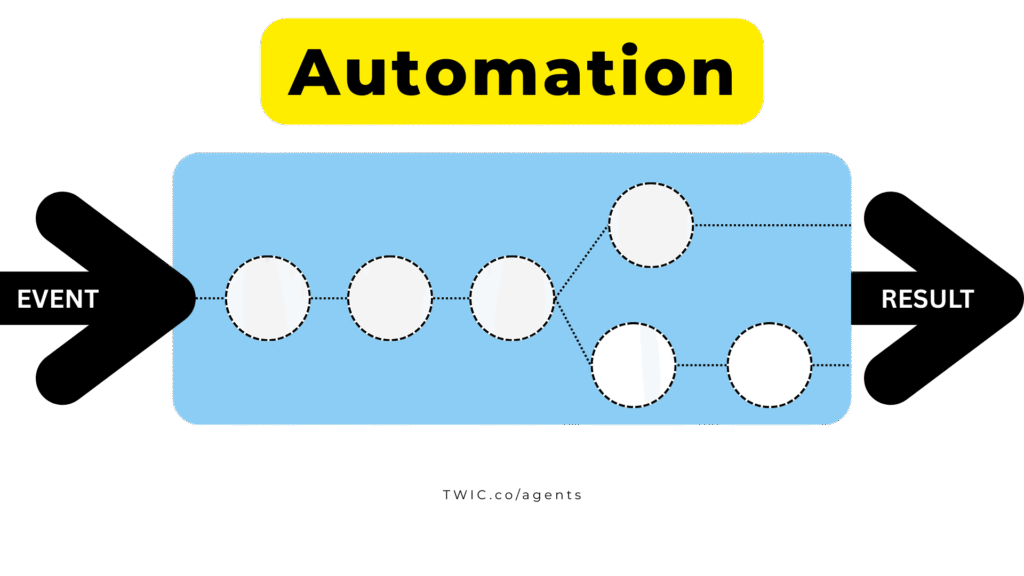
Automations.
So, automation (or workflows or processes) are usually predefined steps that allow you to achieve a specific, repeatable result given one particular action or event. Someone would create a system or a workflow (with tools like Zapier, Make, Syncaroo, etc.) that allows an action to trigger a specific result.
For example, an event occurs when a user is added to your inventory system. The workflow then ensures that they receive a user account, are added to an organization, and have their billing details set up. Once all this is completed, based on their organization, either send them template A or gather additional information and send them template B.
Automation is rigid. You predefine it, manually create the steps, and connect the pieces to tell the system how to go from an event to a result.
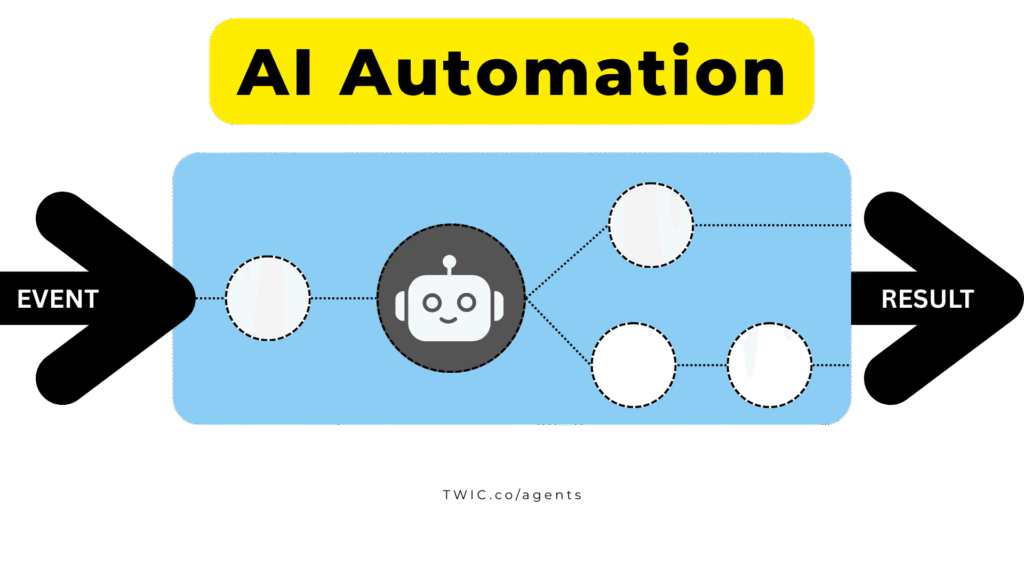
AI Automations
Now, with the addition of AI and ChatGPT and all these AI APIs, there is a new trend of adding AI helpers into these processes.
So we’re replacing some of those manual steps with a confined AI module to help make the process or the task more dynamic.
So, returning to our example, let’s consider an event where someone is added to the CRM, and we want to create a custom email introducing them to the space.
Now that could be “add a bit of humor”, “add a plant pun”, “add something that they may not know about the city that’s related to their industry”.
And then, based on the organization, send them template A or B. So you’re seeing it’s not a complete rewrite of the system, you’re just making it more dynamic so that five people from the same organization, or five people from five different organizations, are all getting slightly different, tailored messages.
But there’s no human setup here of saying “if industry equals X, then do Y”.
You still have predefined workflows, and you still have a repeatable and predictable result for every event.
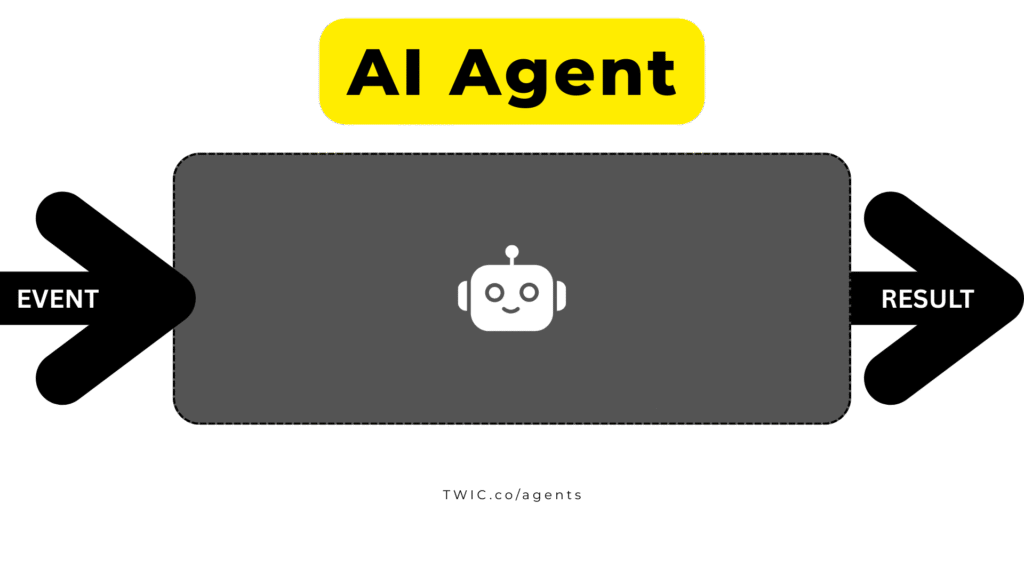
AI Agents
Where AI agents come in is that you don’t create the steps. You give the Agent parameters, instructions, and guidance, and increasingly train them based on previous results, to get closer to your preferred result.
Going back to our example, let’s say a user is added, and you give the AI agent the task of making the user feel welcome by providing onboarding, neighborhood, and other advice.
That could (depending on which systems your Agent is connected to) welcome them via email or SMS, asking if they need any help setting anything up.
If they need help setting up their printer, get the printer set up information, and guide them through the rest of the onboarding steps, making sure their accounting details are filled out. You could also give them best practices. Or even look at their industry and then prepare introductions for your community manager to send via a Slack message or email.
It could even look at fields they may have signed up with in their onboarding process and recommend local eateries or places to hang out that may be relevant to them.
So it’s pretty open-ended, but the main takeaway is that there are no predefined steps compared to AI automation.
Each flow through this may take different steps, and the agent has to make up their own process or workflow to get close to that desired result.
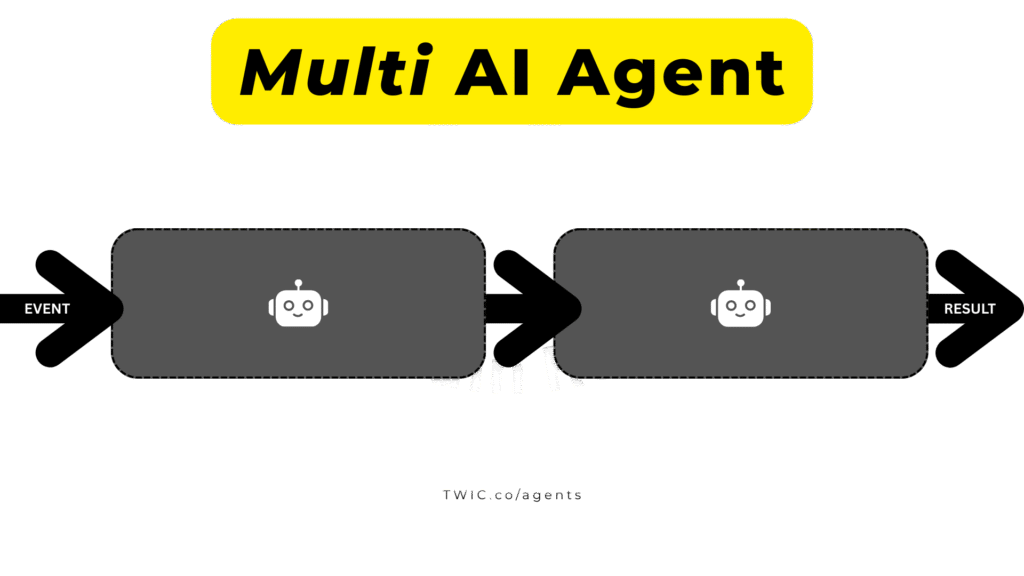
Multi-Agent Flows
Now, I’m gonna take this one step further. We’re seeing a huge new trend (since the first recording I made of this edition): the addition of multi-agent frameworks.
As in the previous example, it is difficult to ask one agent to do five different, specialized tasks.
- Finding local places to hang out
- Sharing best practices
- Handling technical setup queries
- Running accounting onboarding
- Doing account checkups.
We could break up these specialized tasks into separate agents that can either work in a workflow, in a process after each other, and hand information to each other.
They can even work concurrently, so all these different things can go out (when built right) when someone interacts with multiple agents or one agent, orchestrating the rest of the agents.
Shorter Definition
That is my slightly elongated and technical definition.
Let’s quickly hear what our experts would define AI agents as.
An AI Agent is a customized system designed to act on your behalf to perform specific functions. It is trainable, learns continuously, and operates 24/7.
It has access to “unlimited” information. Essentially, it’s like another team member that we have to complement our existing internal skill sets.

Coming from a layman’s perspective on understanding the difference, especially between generative and agentic AI, we think of AI agents as tools that know how to respond, reason, and then take action.
While Generative AI is all about creating content, it is only as good as the information it was trained on. While Agentic AI iterates on that, it is taking the form of machine reasoning and taking actions in more advanced workflows.

For me, an AI Agent focuses on a specific piece of software, or in this case, a marketing channel.
From there, they’re further defined across four areas: persona, objective, data, and style.
Persona is the way it talks to other human beings and the way it talks to us.
Objective is what it has to do, so it understands the task at hand.
Data could refer to our stock and FAQs.
Style is the human touch regarding how it responds, so it’s not robotic.

Why now?
So why now? Why take the time to research and dive deeply into AI agents?
To better understand this, I prefer taking a macro view of surrounding industries for insights and trends before they disrupt coworking from beneath us.
So, if we look across the tech world, we see major firms betting that AI agents will continuously replace a whole bunch of specific software. We also see a shift towards workforces that are both human plus AI.
To further highlight this, let’s start with the software side.
Microsoft CEO Satya Nadella noted that they’re seeing a “core application architecture” that is rapidly changing. Going on to say that AI Agents are increasingly powerful as they won’t be bound to any one piece of software application or database.
What Satya is saying here is that when you write software, you’re normally restricted to what it can do, see, and talk to, whereas AI Agents will not experience those same restrictions.
Salesforce’s CEO, Mark Benioff, takes it a bit further.
At a recent panel at the World Economic Forum in Davos, he said, “today’s cohorts of CEOs will probably be the last to lead all human workforces”.
Could you take a second to think about that?
He’s saying that we’re not going to acquire software or Agents, but instead are going to start “hiring” them—a significant mind shift, albeit subtly.
But you’re probably thinking, “AI has been here for a while now, what’s driving this new overwhelming momentum behind AI Agents?”
And while there are quite a lot of factors (and this is the part that’s probably gonna age like milk), there are four main things that I think you should think about:
1. Agent Developer Kits
Companies like Google, Vercel, Perplexity, OpenAI, and others are releasing agent development kits. These kits directly lead to the creation of more agents.
Development kits are like “helper software” or frameworks that make building agents even faster, cheaper, and more powerful. Initially, people had to manually code instructions in software engineering; then, firms introduced abstracted languages and frameworks. Writing complex software has become increasingly easy.
With the development of agent developer kits, it’s becoming so fast and so easy that we’re getting to a point where you could use AI to generate AI Agents.
2. Increased funding
We’re also seeing more funding. Andreessen Horowitz, the VC firm, recently updated their thesis on AI Voice Agents.
They joined a large group of investors who are backing AI agents, especially those working in what they call “unsexy” (aka tedious and laborious) industries.
But why am I singling out Andreesen Horowitz? In 2011, Mark Andreessen coined the saying that “software is eating the world.”
So if AI is now eating software, AI Agents will eat the world. Right?
3. The Model Context Protocol
The third important point is the new Model Context Protocol (MCP).
What this means is that AI agents have access to more things.
The simplest way to explain this is to think about computers, phones, and everything else. Before a universal plug, it wasn’t easy to connect different cables to different machines to get them to work together.
MCPs are like USB ports that let your agents connect to different systems.
This protocol lets your AI agents speak to external systems (like your CRMs or web platforms that may not have robust APIs) but also gives them access to possibly proprietary, private, or secure databases or systems that are generally not accessible outside your organization.
4. Multi-Agent Systems
These three trends contribute to the growing momentum behind AI agents, but I’d like to address one more: Multi-agent systems are being introduced and popularized.
For more on these systems, see Google’s Agent2Agent protocol, IBM’s MAS report, or LangChain’s guide.
These systems mean that agents can see more things, speak to more systems, and efficiently assign tasks, files, or processes to one another.
So, going back to our previous example, instead of building an “AI Agent for Coworking Spaces” that has to do everything that goes into a coworking space business, and kind of does each of these tasks “okay”.
You can now have, for example, a team of AI Agents. One is highly trained in selling on-demand services, and another is perfectly prepared to wrap up, summarize, and warm up an enterprise lead so that they’re qualified and excited before bringing in a human salesperson.
When the on-demand Agent detects this is not an on-demand request, it can hand the details over to the enterprise Agent, who prepares and gathers more quantifiable data and then gives that to the human salesperson.
The human salesperson then closes it and marks the deal as closed in the CRM.
The enterprise sales agent could then detect that certain things need action in different departments. So, it pings a “front-of-house assistant agent” to prepare the community team to make day one amazing for this customer. It also pings the accounting agent to ensure billing has everything they need, but you get the idea.
We’ll likely reach the point where each department has one (or more) specialized agent, and they’ll be able to speak to each other securely and reliably.
Who has hired AI agents?
With that background, let’s quickly dip into who is actually implementing AI agents into their businesses.
At Orega, we spent a lot of time investigating AI before we invested.
Initially, we used AI as a GPT-like tool to streamline work and improve basic processes. But we have just hired an AI agent to support our inbound leads. But we spent about 11 months researching this, looking at our capabilities and what’s on the market.
We are certainly not late to the game, but we’re certainly not early adopters. We approached it very cautiously. We ensured we didn’t lock into something too early in development. We really wanted almost to take the approach of Apple.
Apple, I don’t think, is the most innovative brand when compared to its competitors, but when it does do something, it does it right.
We started using AI about a year ago for a lot of content on the marketing side. That was the first implementation piece. From there, it started moving into the sales portion of the organization.
We started looking at how we can use AI as a chat agent to get in touch with our customers and provide them with information quickly after hours and during office hours.
So, we started in marketing and moved to sales. We’ll start looking at using it in other components of our business as well. But those are really the ones that are “easiest” to implement, where you see a lot of return in a very short period, that is very, very tangible.
Regarding how we’ve investigated and implemented AI at 25 North, our team members have a lot of personal curiosity about investigating AI solutions.
We are all probably using ChatGPT in some way. There’s a lot of personal interest. It’s such a quickly evolving field, so as individuals in our roles, we utilize generative AI tools a lot.
As a company, though, we’ve embraced these tools very cautiously and thoughtfully. There’s a larger brand reputation at stake, and when there’s so much moving in a field so fast, we want to take a really thoughtful approach to what we’re putting our efforts behind.
Not only our dollars, investment-wise, but also what we’re staking our brand reputation on. There’s a bell curve when it comes to adopting new technologies. There are innovators and early adopters. Most people are in the early majority, and then there’s the late majority, and there are laggards.
We don’t want to be in the late majority lagging crew, but we’re not quite comfortable with the early innovation crew and how we want to protect our brand.
We currently have an agent we’re piloting, which is working for our direct inbound leads from our website and performing quite well. Uh, and now we’re just working on an AI agent for the broker community.
So we want brokers to call us and reference our availability on our website. But I want to get to the point where they can WhatsApp our AI agent and within 30 seconds have an office match, book a tour, and get it straight in our diary.
But with the broker community, we will be very clear that it is an AI agent.
Regarding the AI agents that we’ve implemented at 25 North, we really appreciate the use of a tool made by Uniti AI.
This tool’s Agent is our first point of contact regarding new leads coming in through our pipeline. The idea here is that we’re not replacing a task that humans do best—doing a deep dive into the needs and wants of our leads: the personal connection and warm, evaluative relationship-building work – the agent is not doing any of that.
It’s on the front lines, doing the tasks we cannot do fast—getting responses done on evenings and weekends, responding to really hot leads from places that need response times within 10 minutes. Those are things that our human team cannot reasonably get done.
So we’ve been thrilled to have a tool like that, which can handle some of that rote work that requires a lot of repetition and speed. The tool filters leads into a place where they can have a great, warm, very customized human connection with our team.
We use an AI agent on the sales side.
Right now, it is only an email. That’s how we have it set up. We’re in the early stages of implementation. We’ve been using it and gathering feedback on it. We’re happy with the feedback. We’re happy with how it’s working.
But it is in the early stages.
We segregated a portion of our revenue stack and only have it pointed at part of that.
It’s focused on online bookings and e-commerce, i.e., we provide information so people can transact online. The agents mean we can also give information promptly during on- and off-hours.
I ran seven coworking spaces with no employees. We automated everything and used HubSpot and similar tools.
We sold those businesses a while ago, and I wish I had AI agents now.
We’re all post-COVID, so we like self-service and stuff like that. In a world of self-service, AI agents are fantastic as they can quickly answer your customers’ questions.
As all of the questions they’ll have are contextual around your business, all you need to do is ingest knowledge about your business into the agent, and then it can answer those questions.
It’s great for customer support. It’s great for quickly fixing problems that your customers are having, and there are tons of opportunities there.

AI Agent Wins.
This got me wondering about the actual results so far.
Are these AI agents actually driving business value for coworking spaces?
The success we’ve seen with this AI agent has been really tremendous.
Our team can’t get back to hot leads, especially coming off a platform like a Google or Meta ad, where response time within two to 10 minutes is essential. We previously missed those opportunities, especially if someone was out on a weekend.
(As a salesperson, you should be able to take the weekends off, which is something we want our team to have.)
This tool has been essential in improving our lead response times when we want to give our human team time away.
Not having to wait to get our leads’ info on evenings and weekends was another crucial area in that it has removed barriers to sale when the lead comes in ready to purchase.
Especially for products like meeting rooms and flex desks, people know what they want, but we might still have had someone in the pipeline between the lead’s coming in and wanting the product and their purchase action.
Our Agent has also really streamlined that process, where there’s not a ton of follow-up needed or additional information needed, but a lead needs to be moved through the process. This tool has been essential for those kinds of sales as well.
We wanted to reduce the risk of the testing and implementation process by only tasking the Agent with low-ticket items and requests.
If there was going to be a bad user experience, we didn’t want to risk a high-ticket revenue item. So our wins wouldn’t be on the revenue side.
The win would be on the comfort side, and looking honestly at the tech and saying, “Is this thing capable of creating an interaction with our customer that is in line with how we speak to them?”
And we’re seeing that it does so far. And that’s a huge win.
We’ve been piloting our AI agent for about eight weeks.
It has increased our lead-to-tour conversion rate by about 8%.
On average, we’re seeing a 10-point increase in the conversion rate from lead to tour for operators who work with Uniti.
Obviously, it varies by operator and lead volume, but generally speaking, we’re seeing a 10-point increase in conversion rate.
And generally, it’s not coming down to the language being better; it’s speed.
Engaging leads in the first 30 seconds, 24/7, is likely to result in a higher conversion rate than whatever you’re doing today.
It’s just how the real estate industry works. Its consumers are increasingly expecting. They’re shopping through multiple options.
What we sell at the end of the day is speed. Everything else has to work, or it can’t be a production-level service for our clients, but at the end of the day, if it works, you’ll see a 10-point increase in the conversion rate.

AI Agent Builders
And now let us hop quickly over to some of the companies that are building in this space.
What do they believe are the most significant opportunities or potential for coworking spaces to get right, using AI agents?
Our thinking about agents’ value revolves around dealing with customers. So much in real estate is all about people.
And managing a coworking space is all about managing people. Whether that’s when they’re coming to you and looking for space, when they’re onboarding, or when they’re an existing member of your space.
They have continuous questions, they’re looking to grow, or they haven’t paid their bill on time, and you need to follow up with them and collect payment.
It’s all about continuous engagement with customers.
If you logically deduce many of those interactions, there are many of the same four or five workflows that community managers are dealing with. So, we see the opportunity for AI to support those people in more efficiently managing those conversations at scale.
We’ve started where there’s the most near-term value at the top of the funnel, helping operators convert more of their leads into customers.
One thing we see across all operators is that they’re running a kind of inbound-driven sales funnel. They’re running marketing, both online and offline. People come to them, and their sales process is about how quickly you can engage, qualify, and convert those leads.
And as many operators wear many hats, closing these leads often comes down to people responsible for managing existing members and doing several other things. Unfortunately, that ends up in today’s environment, with potential leads going hours, if not days, without any effective response.
As real estate is a market where people have a lot of choices, how quickly you can engage them determines the likelihood of converting them.
And so by delivering a solution that enables operators to engage leads promptly and more effectively, we’re helping them close more deals.
At Flexspace, we see AI agents’ most significant potential in making technology more intuitive.
I’m genuinely excited about the shift to AI agents because once we can open technology to one conversational system, people can deploy technology intuitively.
That, for me, is incredible because it will make technology so much more accessible to many more people.
Today, coworking operators need to navigate many hoops and different systems in their tech stack. We are excited about AI agents’ ability to connect all the dots for operators and allow them to focus on the most important things: hospitality and community.
We are focusing on two main areas regarding AI Agents in Coworking.
The first is pricing. There’s a huge opportunity to build a better pricing engine using AI agents.
Pricing should not be a static number. So many different variables impact prices, and obtaining the optimal pricing point in real time for every single resource and asset in your location is tough.
So that’s one area where Flexspace puts a lot of effort into building a smart pricing engine to optimize revenue in real time.
The second big area of focus for Flexspace is to build hyper-personalized marketing activities. So we started with building AI-powered retargeting marketing campaigns to get people to come back, increase retention, and grow lifetime value.

We help operational real estate operators to streamline their operations through AI agents.
As you’ll know, Flex isn’t necessarily the most forward-looking sector when it comes to embracing technology. Throughout the industry, there are many inefficient processes. Many operators still use outdated manual methods that can be optimized through technology.
The traditional way of working was fine for many operators and even profitable. However, we’re starting to see that many operators are finding it harder to focus on the top line, so much so that revenue growth in some locations has slowed.
2025 is the year when everyone focuses on the bottom line, rather than just the top line.
That means the traditional, fatty, loose way of working for many operators is no longer appropriate. No longer viable, with lots of pressure on this term “efficiency”. That’s where the opportunity to use technology, particularly AI agents, comes in.
Opportunity to optimize resources, to become leaner, and to help the best operators become more profitable and have higher margins.

Where I see the most considerable potential for AI agents is counterintuitive.
Coworking is all about hospitality. We think of human-to-human hospitality, which is very accurate. But great hospitality is also about meeting our members where they’re at and giving them quality answers when they need them.
AI agents are super helpful because you can leverage your agents anywhere, and anyone can access them and get the information they need precisely when they need it. The counterintuitive part is that you can increase the customer experience by embracing agents to help your customers when they need help.
We think about AI and how it should be applied because we’re not trying to develop the “next new product” or the “next hot new thing,” because everything is moving quickly.
What we do is create white-label experiences with existing technology. We think about AI voice as cutting-edge technology, but we can bring that in-house, and then you can customize it for your own business and leverage it.
Or chat. So everyone has used ChatGPT or Grok or Gemini or whatever. We can bring that in-house. You can ingest your knowledge base into it, and then you can talk to it, your customers can speak to it, or your employees can talk directly with the knowledge base.
Another thing we’re looking at as AI agents is the blend of AI and human concierge.
AI agents can do check-ins, scheduling, get analytics, and know when demand surges.
And that further enables teams to focus on culture and relationships.
The first place where AI agent adoption could benefit flex spaces the most is internally for their own needs.
Typically, operating teams carry a cell phone, using it to book appointments and answer questions via multiple apps. While much of this can be done online, users often have insufficient information on their mobile devices. A bigger screen would usually be preferable, or one could make voice AI agents available 24/7.
The same agent could then support a user who may call a coworking network. The agent could ask, “Where do you want your office?” and start directing the user, whether it’s two o’clock in the morning or two o’clock in the afternoon.
“Do you prefer a downtown office or a waterfront office?” The AI can then reserve these resources and ensure the person receives a link to access the center. It can also provide information about the center they will visit or utilize.
Additionally, calls are never missed. Thus, I believe the primary advantage of a coworking space is having that “front door” open at all times with all the information you could need, literally at the speed of light.
A human answering a call might say, “Let me check on this, or lemme check on that,” or dive into a webpage—whereas AI delivers information instantaneously; the desired information is ready to be provided instantly.

Myth Busting
When it comes to disruptions of this magnitude, there are many moving parts to navigate.
How are operators picking solutions, addressing fears, busting myths or misconceptions, and exploring some of the best practices?
We had many fears about AI. Our initial fear was that if we introduced it, especially when we’re talking about agents, it would be too robotic.
One of the USPs of Orega is that we’re a very people-focused business. Our team members who sit at reception get to know our clients. Even though our team works in our central support center, we get to know our clients as well.
And we didn’t want to take away that personal touch.
So we were worried it could be very robotic. But what we have found is that when you train the persona correctly, it can hit our tone of voice, support our work, and increase our efficiency.
The number one myth is that you must use humans or AI exclusively.
I always encourage all of our prospective customers who are thinking about integrating AI—and our team, when thinking about the products we build—to create them with the human at the center and the AI as a kind of added muscle (to multiply the efforts of the humans).
The key to any good AI agent product is integrating it into the workflow with the existing humans at the organization so that they work together to get work done.
An elementary example of what that means in practice is if an AI Agent is dealing with a lead, they’re always like keeping on cc their human sales rep counterpart..
That person can step in at any time and take over that conversation. So making sure it doesn’t live in a silo, but it’s integrated into the workflow, is key.
So, in terms of fears for AI, we certainly experienced them internally.
Our biggest challenge was quality control, understanding that the AI would replicate our voice.
The first question was whether this would degrade the user experience from IQ’s perspective. The short answer is that you have to be on top of it. You can use it as a tool, but you can’t rely on it alone.
It is a tool to enhance the sales and marketing teams and improve productivity. That’s where we see the enhancements occurring.
However, speaking in your voice takes time, and you will need to train the AI bot to do this; you’ll need to train ChatGPT. These developments take time and come with innovation within AI, which we expect will happen. Nonetheless, that fear was present.
The other fear was looking at people and asking, “Will this replace jobs? Is this going to replace me? If I bring this AI chatbot in, does that mean you no longer need me?”
And one of the things about our business is that AI will allow us to become much more efficient.
But we are an IRL customer-facing business, and our real value prop is our ability to connect with people. So AI helps us do that, but it certainly could not remove that when it is at the core of our value proposition.
The common misconception, or the complexity, that people raise around AI is the inability to deliver a personal level of service while simultaneously embracing AI.
For many operators who pride themselves on their personal level of service and how they provide service to their customers, that’s an important consideration.
I fully acknowledge and agree that people choose our products as flex operators because they value human relationships and personal experiences. AI doesn’t need to disrupt this.
Implementing AI in the right way augments human interaction by taking on routine and mundane tasks, leaving people to focus on creative and critical thinking, which provides value to customers.
The biggest myth I would like to address about AI agents is that they will replace humans.
AI agents will be successful by integrating into existing workflows and automating and frictionlessly performing mundane tasks in everyday life.
Learning Curves and Swerves
When implementing any technology, there’s always some sort of learning curve.
These operators share what they found as the biggest learning curves.
So when it comes to how our team behaviors have had to adjust around introducing an AI tool, it’s taken the same amount of time to train the tool as it would to train a real human being. So I think once we could adjust to that reality as a team, “Oh, this tool’s not gonna be something we can just plug in and it will run perfectly right away”.
You have to imagine that it is like any other team member you’re bringing in; it will need to understand your processes, your language, and your metrics for success. This is very similar to how you would train another sales team member.
So our team had to get used to the reality that sometimes it takes longer in the initial phase to train AI than it might take to do it yourself. But we’re playing the long game.
Once you can get the tool trained and put in that initial investment, it will save you a tremendous amount of time.
Another aspect that requires us to be more self-aware is our processes. Our SOPs have to be rock solid to help the AI tool understand where it needs to plug in. Especially in sales, the process can be so intuitive that you’re just making decisions by the seat of your pants, flying based on the feedback you’re getting from that lead.
We’ve had to step back and document and think very clear-headedly about how exactly we want this process to flow in its best form. And that’s also no different than how it would be when you train a new team member.
When training an AI tool, you have to think like a manager: “Alright, what context do I need to give this person? What is the metric for success?” It can’t just run on instinct. You have to train its brain, and that definitely requires some behavioral adjustments from the team.
But we needed to implement these anyway. You need solid SOPs and good documentation, forcing us to fast-track some detailed technical process buildouts.
We’ll start to see over time that we will integrate AI into more and more portions of our business, looking at the revenue stack and working our way into the higher pieces of our revenue stack. We must use it to provide people with real-time information that they will want.
In the fullness of time, this may be two or five years from now, but the consumer, at some point, will go to a website. If they can’t get access to very detailed information from an agent, they’re just going to go somewhere else because you’re not going to give them the information that they want. The quality of the interaction may not be as good as it is with a human, but getting it instantaneously has value.
So what you’re going to see is it. In the early stages, people are going to favor timeliness over quality. That’s what you’re going to see. Personally, I would rather have a lesser-quality experience with more information than an experience I have to wait for to get more information, because the timeliness is that you want to move fast.
We are currently redoing our website, and one of the considerations is how we will implement AI into the website experience. We are actively thinking about it. Although we haven’t decided on the integration yet, we recognize the need to stay current.
Redesigning a website is quite time-consuming and comprehensive. So we’re thinking about it, designing it, implementing it, and integrating it into the business. We want to be prepared for these things so that we can act quickly when the time is right.
And when I say the time is right, we’re talking within less than 24 months.
I’ve got a couple of thoughts here. First of all, it’s a misconception that operators introducing these tools will cause their teams to run a million miles in the opposite direction. Implemented correctly, the team should embrace it.
Because what you’re doing as an operator is replacing manual, repeatable work with work that is, hopefully, more stimulating. They often run these tools and avoid having to do the manual, repetitive tasks.
So, you should see that you’re making life better for your teams using these tools.
The other thing is that, generally, having these conversations, the temptation is to think that everybody is living and breathing this technology in the same way that perhaps you and I and others are on a day-to-day basis, and are obsessed with where things are going. Most people are outside of this bubble and are not engaging similarly.
So, some people you have a conversation with, and this term “AI” causes friction and causes people to build up a level of anxiety before you even have had a conversation. And how do you break that down?
That comes with time as this technology becomes more mass market and more widely understood. And it comes with learning and training. Training people on the opportunity to use this technology for their roles, teams, and businesses will also help break down some of that friction and some of that anxiety.
We found the agent to be too helpful to our clients.
When trying to sell, you want to sell your most valuable stock first. However, being a very honest data-driven tool, the AI agent offered our clients the best value. While we want to do this, we found that sometimes, unfortunately, we were losing out on slightly bigger sales because our Agent was just a bit too friendly to our clients.
This isn’t terrible, but it was an interesting learning experience.
I think everybody is a little scared of AI. There’s a lot of job loss and stigma around adopting AI, as well as how it negatively impacts your customers.
There’s an emotional element here that is important to consider. And I think that, my advice or my sort of frame for operators for how to think about this is that none of us can change the fact that AI is going to continue to accelerate in terms of the level of intelligence that’s being offered and also the applications that are being built and the consumer’s expectations being, um, rapidly changing.
We can control how we implement it thoughtfully in very narrow, discreet ways that allow you to test before you make significant changes to your systems.
Challenges
But it’s not all gravy.
Implementing technology like AI agents can present some challenges.
This is some of them.
As one would expect, implementing an AI agent like this has presented some challenges. Indeed, the tool’s language doesn’t always sound like our brand. We’re getting there, but it has taken time, slow training, and investment.
It was inevitable that some heavy team involvement was needed to train this tool in our sales process. We have lost some leads during this, and that’s no different from teaching a human.
AI is not perfect, and it’s not going to get it right away. So yeah, we’ve seen leads get misquoted occasionally, or the tool may have come across as more brisk than we would prefer.
We’ve had to work through those initial drawbacks or hiccups.
When we rolled out the agent, we had many challenges and concerns. The primary problem was what would happen if the agent said something wrong or misquoted the price. Fortunately, we trained the agent very, very well.
We spent so much time checking the data we gave the agent that our primary concern was potential misinformation. However, we’ve found the opposite. If the agent didn’t know the answer, it escalated and was immediately handed over to a human being.
Outside of TWIC and at my day job, I spend a lot of time advising workspace leaders and leadership teams about the evolution and cross-integration of current and future technology.
A big part of that job is removing the rose-tinted spectacles and exploring the potential risks or threats that new technologies can present.
While I can’t share the details of these conversations, I can share significant areas that I’d recommend you think about in your approach to AI agents.
1. Data Security
First, data security. What do you need or want to give specific AI agents access to?
Now think of this: Would you give your marketing intern access to all of your financial data? Probably not. You shouldn’t give your marketing AI agent access to that either.
So, think about how, when you connect all your systems, how are you controlling access to specific subsets of your data?
2. Ownership
The second challenge that I want to keep in mind is ownership. Now, this edition is more about AI agents, or Agentic AI versus Generative AI.
Still, it’s part of what agents are being tasked to do, for example, creating flyers, touching up photos, and generating video. The list goes on.
A question you should ask yourself, along with the platforms you plan to use, is, “Who owns the output of the agent?“
On that note, you should ask who owns the data as it moves through the agent’s workflows.
This is still a gray area and has not been settled in any court cases yet.
3. Representation and Biases
The next challenge I want you to think about is representation and biases.
Now, while AI agents are being developed globally, many of them are using LLMs or engines created in places like the US and China.
You should always ask yourself whether the logic and output of these agents or systems may be biased in some way or form that goes against your local community and cultural societal norms, and how best to adapt or tweak the setup, prompts, guardrails, and outputs to handle those situations better.
Agents all-the-way-down
Now, regarding challenges, I wanted to look a little bit more at this idea of multi-agent setups.
There is this parable that the world is riding on the back of a turtle.
In what is part internet meme and part philosophical query, Stephen Hawking is said to have asked, “Well, what is that turtle then standing on?”
Well, another turtle. “And then what is that turtle standing on?” Well, another turtle.
This is usually referred to as “turtles all the way down”.

If we adopt this idea of agents running tasks on top of (or next to) other agents and eventually being agents all the way down, I do have to wonder what happens if something goes wrong.
While all these agents work autonomously together, who is responsible if a small error becomes a bigger problem?
I think the answer is probably the turtle at the top.
The way we construct our agents is that we typically think of them as “master agents” who are doing the core job. Then, there are a lot of feeder agents that provide information to help the master agent do well.
And I think the master agent is typically where we’re building in the most guardrails and is responsible.
When we’re talking about agents working with agents that are working with agents, one small error can become a big problem down the line.
The buck has to start with your team.
It’s an excellent question. I was thinking about that in the context of self-driving cars.
With Tesla, Waymo, and others, we see some car accidents, and that raises the question, “Whose fault is it when there’s no driver in the seat?”
We’ll still need to figure it out. I don’t know if there’s a single answer, but overall, once an agent takes control, we’ll see fewer accidents in all aspects of our lives.
It’s about the quality of the data that you input. That’s the most important thing. So if we go up the chain, it probably starts with whoever inputs the data.
We’ve considered it as a vendor by building guardrails into our product as far as possible. With these kinds of agents, it’s not life or death, obviously, but you’re definitely playing with live revenue.
So, these agents must operate with the proper guardrails in place, which are set, pre-programmed, and ultimately set by operators or customized by operators.
I believe it is essential to have clear accountability and defined ownership boundaries regarding who is responsible for what.
If you have different agents handling various tasks, it’s vital to ensure that there are guardrails in place, including always having a human involved if something goes wrong, of course.
And then, for transparency, it’s essential to have logs and a clear audit trail of what happened. “Why did it break?”
Pro-tips
Now that these companies have implemented AI agents, we asked them to share their best practices, lessons, or recommendations with you.
When considering how to use AI, I recommend how we’ve done it.
Examine your revenue stack and focus on lower-probability revenue or revenue items.
Of course, we don’t want anyone interacting with our brand to have a bad experience. But if you’re going to roll things out and understand that they work, you have to get them into the field.
So, putting it into a specific revenue stack, like your virtuals and meeting rooms, right? Like, picking something where you’re saying, if this goes wrong for a week or two, this is not gonna have profound impacts on the business. Then you can start to implement and grow it over time.
In speaking with other operators and giving them advice on implementation, I think I would say start small, get comfortable, and once you do, you can ramp up quickly.
Your timing can be slow and then fast. So, take your time, get comfortable, and set it up how you want. Once you have that comfort level, you can accelerate those timelines.
But that’s how you want to approach implementation: slow, then fast.
You gotta ask questions.
“What do you want it to do?”, “What is your end goal?”, “Are you trying to reduce overhead?”, “Are you looking to increase efficiency?”
It is important to put guardrails in place, not only to ensure that the technology behaves correctly on the phone and stays on task, but also to keep in mind our goal for “what we want to achieve with this?”
Because it really is limitless, there will always be so many aspects of your business that you can improve and streamline with AI.
Figure out what you want to do with AI, develop a plan, implement it, and then measure it.
Operators should consider how well the AI agent integrates into their workflow. No one wants to use an AI agent if it adds to our everyday work and processes.
However, AI agents can be successful as long as they can be effectively integrated, provide value, and automate some repetitive and mundane tasks. If you use the AI agent as a side ‘project’ to your ongoing work processes, there will not be much adoption.
Generally speaking, if you’re not considering how to leverage AI within your organization, it’s likely because you’re not processing enough requests yet, which is understandable.
You still need to handle everything yourself; you don’t have enough going on yet to warrant that level of automation. However, AI is a real opportunity once you have two or three locations.
You’ll need to embrace it, but you’ll also have to approach it skeptically and focus on applying it.
Honest conversations about that are essential, whether with us or another vendor.
Right now, AI is the hottest topic, not just in marketing but in business in general.
I recommend that when you’re looking at AI, you do not rush into it. Take your time and do it right.
So many AI companies are popping up left, right, and center. Some of them, if I’m honest, are not even AI. They say they’re AI when they aren’t. They’re just riding this wave.
I would say take your time, do not rush into anything. Look at all of the options. Speak to peers in the industry. If you have a good relationship, speak to your competitors.
Take your time and do it right.
Privacy, data, and ethics are the top priorities. The most important thing is being transparent about how the data is being used. You want to ensure you respect and obtain their consent to use these AI agents.
Additionally, training and fallback are crucial; our agents are always learning.
There are real coworking scenarios you want to train on, and it’s essential to have a human fallback to handle any edge cases.
When it comes to implementing some sort of AI agent in your business, consider two things.
The first is: do not be scared of the initial time investment.
I think about AI like this: if you were trying to teach your young child how to load the dishwasher, you might think I could have loaded it so much faster if I did it myself. However, once my kid has mastered the dishwasher task, it will save me a lot of time.
And so, just don’t be afraid of the initial time investment required to make an AI tool a valuable extension of your team.
It’s similar to the time it takes for a real human to excel at something; you have to build its brain. It doesn’t come with intuition, so you must put in that initial effort.
But don’t be scared about that, and don’t give up. Please keep working with the tool until you can get what you need. That long-term time savings is going to pay off.
And the next thing is: take this as an opportunity to simplify your processes.
Simplify and think about what particular branch of, for 25 North, this is for our sales process.
“What branch of my sales process do I want AI to take off my plate?”
Don’t just assume that it can run on its own. Think about it as if you were going to make a hiring decision. Where exactly do I want this person to plug in? What skills do I need to have? And then how will I give that thing laser focus toward its goal?
So simplify your process. It’s an excellent opportunity to make sure that what you have had in your head is on paper. And yeah, see it as an opportunity to hone your processes and document SOPs you haven’t had before. It will help you get more organized.
What next!?
Given the speed at which AI agents are moving, I wanted to add a new section to this report called “What Next?”
What do we believe, or what are we already seeing, that could be coming just around the corner?
AI will get (even more) exciting when organizations figure out how to structure their data to give their agents access to it to manage whole customer lifecycles.
For me, it’s the 80/20 rule.
If eighty percent of transactions are still booked or processed offline today, it’s heavily focused on booking tours, visiting the space, and speaking with someone to arrange a meeting room or an office.
In the next two to three years, we will see that 80 percent of transactions will happen online, while only 20 percent of deals will be closed offline by salespeople on the ground. This will be primarily due to much greater efficiency, such as effectively removing frictions to discover and book spaces.
All the information should be and will be online. We’ll get much better at virtual tours and virtual maps. People can choose the space they need and get all the information online. Some will still opt for a tour and come in person to see the space, but for the most part, transactions will be initiated online.
We will also see AI agents discovering and booking spaces, not just for individuals but also for companies. So we’ll start seeing AI agents making more sophisticated portfolios for companies and being able to plan, book, and buy memberships and offices across different locations, maybe even different operators, leading to much higher utilization rates for coworking and overall more revenue.
In terms of broader potential, I’m excited by many future use cases.
In particular, I’m eager to use AI to optimize community building through digital platforms that foster better networking, deeper relationships, and increased member engagement.
This is a specific area that I find exciting.
We’ll be more efficient and profitable as operators. Our teams should be happier with their work.
We should also provide a more personalized and meaningful customer experience and service, using our people in the right ways to deliver those services.
There are essentially three main topics I want to quickly dig into here. One is concurrency. The second is AI agents for tasks. And the third is fully automated agent-handled experiences.
Concurrency
Starting with concurrency, this is a technical term for when different calculations or tasks can happen simultaneously.
It’s usually used when referring to multiple software instances that talk to the same centralized database. Think of this as all the different systems within a hospital interacting with the same patient database.
With the proper data structure and planning, AI agents will gain the ability to operate concurrently, all working on or around specific customer data without blocking or overriding each other’s work.
Your teams will get a productivity superpower—or at least they can do more things only they can do.
The AI agents handle the rest of the stuff in the background and automatically, while tasks are being done and handed between systems and teams.
Specialized Agents
The second is AI agents for tasks.
Following my earlier thread, we will see particular and specialized AI agents enter the coworking industry.
For example, in accounting (chasing, invoicing, updating reports, preparing folders) or scheduling (whether for your janitorial, maintenance, office turnovers, or reminders for member celebrations).
We’ll see specialized AI agents for technical support (e.g., internet issues, setup guides, or printer debugging).
We’ll see AI agents in the supply side of our industry (ensuring the toilet paper has been reordered, noting what’s in the fridge, and reordering).
We’ll start seeing more specialized agents being brought into these kinds of areas.
Fully-agent-handled Experiences
And the third area that I’m watching is this idea of fully automated agent-handled experiences.
What I mean by this is we’re getting very close to a point where users’ AI agents or digital assistants can seamlessly find, book, checkout and check in, to your space – freeing the human to interact with your team and community without anyone having to touch a button, move a mouse, or tap a screen.
Behind the scenes, there will be a group of agents across their organization, your organization, and the booking platform’s organization—all working in tandem to make that experience possible.
Conclusion
It’s fair to say AI Agents are not just coming into coworking, they’re here.
The real question is, where can AI agents help your teams do more of the work they love, automate the parts they don’t, while improving your business, brand, and community?
Last Word
And now over to our underwriters for this edition, Francesco at Uniti AI, for the last word:
Thanks, Hector.
We heard from many forward-thinking operators today, and if there’s one lesson to take away, it’s that you really can’t shortcut the process of engaging with and integrating an AI strategy into your business. You have to start small. You have to measure what matters.
You have to learn fast, and you have to keep adjusting. AI isn’t a magic switch. It’s a system. And like a system, it only works when you understand the inputs. Stay close to the outcomes and keep tightening the loop.
The people who think that you can flip the switch and everything will work are the ones who don’t have exceptional results.
The clients we’ve seen succeed are the ones who don’t try day one to automate everything overnight. They’re the ones who try to experiment.
They give AI one small, narrow job to begin with. In the case of coworking with what we’re hearing from a lot of people, that’s coworking, memberships, virtual offices, meeting rooms, et cetera, before you move on to the larger higher price tickets, like private offices maybe where there’s a little bit more risk if the AI goes off script.
But you have to commit to making it better over time. My advice to everyone, really based on hearing from these operators and generally from our work with operators, is that if you’re thinking about integrating AI into your business, start with one problem. Measure it. Learn from it. And then grow from there.
And really, that’s how the future will be built. That’s how AI will be integrated into organizations.
If there’s one major lesson I’ve learned from sitting back and listening to all of these operators speak, it’s that people do want to start small. They’re not ready to go headfirst the entire way.
They want to find small, concrete examples to apply an AI agent to get some early wins before rolling it out.
If you’re interested in learning more, please feel free to reach out to me. We’d love to chat.
Thank you so much to the This Week In Coworking team for putting this Undercurrents edition together.